


2026 Chevrolet Blazer EV: Buyer’s Research Guide for Dallas Drivers
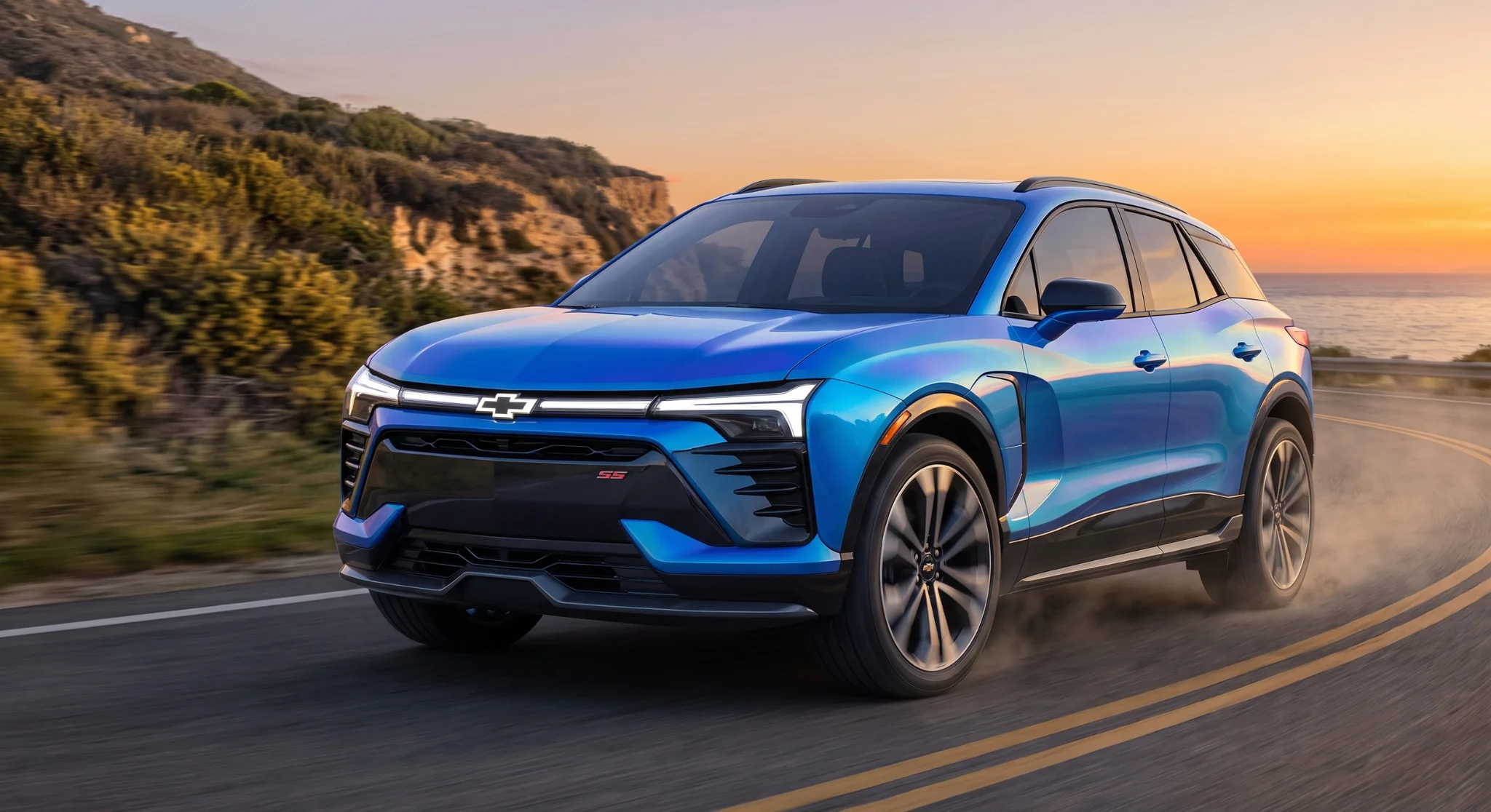
The 2026 Chevrolet Blazer EV is a midsize all-electric crossover built on GM’s dedicated EV (Ultium) platform, offering up to an EPA-estimated 312 miles of range, two drivetrain layouts, and a performance range topping out at 615 horsepower. This guide walks Dallas-area shoppers through range, trims, pricing, warranty, charging, and everyday ownership.
At a Glance: 2026 Blazer EV Key Specs
| Spec | LT / RS (FWD) | LT / RS (AWD) | SS (AWD) |
|---|---|---|---|
| Battery | 85 kWh | 85 kWh | 102 kWh |
| Drivetrain | Front-wheel drive | All-wheel drive | All-wheel drive (standard) |
| Horsepower | 220 hp | 300 hp | Up to 615 hp |
| Torque | 243 lb-ft | 355 lb-ft | 650 lb-ft |
| EPA-Estimated Range | Up to 312 mi | Up to 283 mi | Up to 302 mi |
| EPA-Estimated Efficiency | 104 MPGe combined | 95 MPGe combined | 85 MPGe combined |
| DC Fast Charging | Up to 150 kW | Up to 150 kW | Up to 190 kW |
Range and efficiency figures are EPA-estimated. Actual range varies.
EPA-estimated fuel economy figures are for comparison purposes only. Your actual mileage will vary depending on driving conditions, how you drive and maintain your vehicle, battery age/condition, and other factors.
Driving Range and Performance
How far can you travel on a single charge? It depends on the drivetrain you choose.
Front-Wheel Drive (LT & RS)
The FWD LT and RS trims pair an 85 kWh battery with a single-motor system producing 220 horsepower and 243 lb-ft of torque, earning an EPA-estimated range of up to 312 miles — the range leader of the 2026 lineup.
All-Wheel Drive (LT & RS)
Choosing all-wheel drive on the LT or RS adds a second motor, raising output to 300 horsepower and 355 lb-ft of torque, with an EPA-estimated range of up to 283 miles.
SS Performance (AWD)
At the top sits the SS, which comes standard with a dual-motor all-wheel-drive system and a larger 102 kWh battery. It delivers up to 615 horsepower and 650 lb-ft of torque, an EPA-estimated 302 miles of range, and a 0–60 mph time of 3.4 seconds when Wide Open Watts (WOW) mode is engaged.
What This Means for Dallas Drivers
- Weekly charging, not daily: A typical 30-to-40-mile daily round trip on the Dallas North Tollway or Interstate 635 can cover a full week on a single charge with the FWD models’ 312-mile range.
- Regenerative braking: Every Blazer EV recaptures energy during deceleration.
- One-pedal driving: A refined one-pedal mode makes stop-and-go traffic smoother while feeding energy back to the battery.
EPA-estimated fuel economy figures are for comparison purposes only. Your actual mileage will vary depending on driving conditions, how you drive and maintain your vehicle, battery age/condition, and other factors.
2026 Blazer EV Trims and Pricing
For the 2026 model year, the Blazer EV lineup consists of three trims — the essential LT, the sportier RS, and the high-performance SS — across five total configurations. A key change this year: the previously available rear-wheel-drive configuration has been discontinued, leaving front-wheel drive and all-wheel drive as the two layouts on LT and RS. The SS remains all-wheel drive only.
| Trim & Drivetrain | Starting MSRP |
|---|---|
| LT FWD | $46,495 |
| LT AWD | $49,495 |
| RS FWD | $52,295 |
| RS AWD | $55,295 |
| SS AWD | $62,495 |
Here’s how the trims are positioned:
- LT — The entry point. A well-equipped foundation with the 85 kWh battery, 17.7-inch touchscreen, and standard Chevy Safety Assist.
- RS — Adds sportier styling, including a black-painted grille and full-width LED lighting, along with upgraded interior appointments.
- SS — The performance flagship. Standard Super Cruise hands-free driving technology, 22-inch wheels, the 102 kWh battery, and up to 615 horsepower.
Manufacturer’s Suggested Retail Price (MSRP) for new vehicles includes manufacturer and distributor options and delivery, process and handling fees, which may be subject to change at any time. MSRP excludes taxes, title, license and dealer installed options, accessories, fees and charges. MSRP is not the dealer advertised price. Dealer price will vary. The dealer sets the final price.
Safety Ratings
The 2026 Chevrolet Blazer EV earned a 5-Star Overall Safety Rating from the National Highway Traffic Safety Administration (NHTSA).[Source: NHTSA] Every trim comes standard with Chevy Safety Assist, a suite of driver-assistance features:
- Automatic Emergency Braking
- Forward Collision Alert
- Front Pedestrian Braking
- Lane Keep Assist with Lane Departure Warning
Battery Warranty and Ownership Coverage
One of the most common EV shopper questions is how long the battery will last. Chevrolet backs the Blazer EV with the following coverage:
- EV propulsion battery: 8 years / 100,000 miles limited warranty, covering the battery pack and its components against defects and excessive capacity loss
- Bumper-to-bumper: 3 years / 36,000 miles
- Powertrain: 5 years / 60,000 miles
This information is provided for general educational purposes only and does not constitute legal advice. Warranty coverage depends on the specific terms of your vehicle’s warranty agreement. Consult your owner’s manual or a qualified legal professional for guidance on your individual situation.
Choosing a Home Charger
Imagine waking up every morning to a full battery and skipping the public charging station entirely. For most owners, that means a 240-volt Level 2 home charging setup.
Every 2026 Blazer EV comes standard with a Dual Level Charge Cord that supports both Level 1 (120-volt) and Level 2 (240-volt) charging:
- Level 1 (standard household outlet): Opportunistic top-ups of a few miles of range per hour — fine as a backup, not as a primary method.
- Level 2 (240-volt circuit): Similar to a heavy-duty clothes-dryer outlet. Paired with the vehicle’s 11.5 kW onboard charging, it can replenish the battery overnight.
Installing a Level 2 home charger is the single most impactful step most owners take to maximize the convenience of EV ownership. Before you make the switch, you can value your trade-in through our online appraisal tool to see how your current vehicle’s value applies toward your new Blazer EV.
Real-World Charging in the Dallas Heat
How Often You’ll Actually Plug In
Many drivers assume switching to an EV means planning life around charging stops. In reality, with up to an EPA-estimated 312 miles of range on FWD models, a North Texas commuter covering 30 to 40 miles a day typically needs to plug in only once or twice a week. EPA figures are established under controlled conditions, and real-world range varies with speed, load, and temperature.
Managing Summer Heat
The Dallas climate matters here. Sustained summer heat makes the vehicle’s active battery thermal management work harder, which can modestly reduce efficiency. A few things help:
- Standard heat pump: Captures and redeploys heat from sources like regenerative braking to condition the cabin and battery more efficiently.
- Shaded charging: Charging in a garage or covered space reduces heat stress on the battery.
- Genuine parts on hand: Our parts department stocks charging accessories and replacement cabin filters when you need them.
Charging on the Go: Tesla Supercharger Access
The 2026 Blazer EV expands your public fast-charging options in two ways:
- Tesla Supercharger network: Accessible with an available GM-approved NACS adapter, available through Chevrolet Accessories.
- Standard CCS network: The Blazer EV’s native fast-charging connection, available nationwide.
Maximum DC fast-charging speed depends on the battery pack:
| Battery Pack | Trims | Max DC Fast Charging |
|---|---|---|
| 85 kWh | LT & RS | Up to 150 kW |
| 102 kWh | SS | Up to 190 kW |
A Note on Smartphone Connectivity
The Blazer EV runs Google Built-In as its operating system on the 17.7-inch touchscreen. Here’s what that means for your phone:
- Built in: Google Maps, Google Assistant, and downloadable apps native to the touchscreen — including navigation that integrates charging stops.
- Not offered: Apple CarPlay and Android Auto phone projection are not available.
For many drivers, the built-in Google experience replaces the need for phone mirroring — but it’s worth knowing before you shop if CarPlay or Android Auto is a must-have for you.
Common Questions About the 2026 Blazer EV
Does the 2026 Blazer EV have a front trunk (frunk)?
No. The Blazer EV does not have a frunk. It offers 25.5 cubic feet of cargo space behind the second row, expanding to 59.1 cubic feet with the 60/40 split-folding rear seats down, plus hidden storage under the rear cargo floor.
Can the Blazer EV use Tesla Supercharger stations?
Yes. With an available GM-approved NACS adapter, you can charge at Tesla Supercharger stations across North America, in addition to the standard CCS charging network.
How does battery size vary across trims?
The FWD and AWD LT and RS trims use an 85 kWh battery pack. The high-performance SS uses a larger 102 kWh pack to support its dual-motor powertrain.
What is the maximum DC fast-charging speed?
It depends on the battery. The 102 kWh SS supports up to 190 kW, while the 85 kWh LT and RS support up to 150 kW under optimal conditions.
How does the Blazer EV keep its software up to date?
The Blazer EV supports over-the-air software updates that improve infotainment and vehicle systems over time. For routine service, tire rotations, or diagnostics, you can schedule a service appointment with our factory-trained technicians.
Find Your 2026 Chevrolet Blazer EV in Dallas
Finding the right electric crossover comes down to matching your daily driving needs to the right trim and battery. Our team can walk you through the well-equipped LT, the sporty RS, and the high-output SS, and demonstrate features like the 17.7-inch touchscreen and one-pedal driving on a test drive.
Visit us at 4747 Lyndon B Johnson Fwy, Dallas, TX 75244, or call our team at (972) 763-5444 with any questions about availability, pricing, or charging setup.
Disclaimers
Range and efficiency figures are EPA-estimated. Actual range varies.
EPA-estimated fuel economy figures are for comparison purposes only. Your actual mileage will vary depending on driving conditions, how you drive and maintain your vehicle, battery age/condition, and other factors.
Manufacturer’s Suggested Retail Price (MSRP) for new vehicles includes manufacturer and distributor options and delivery, process and handling fees, which may be subject to change at any time. MSRP excludes taxes, title, license and dealer installed options, accessories, fees and charges. MSRP is not the dealer advertised price. Dealer price will vary. The dealer sets the final price.
This information is provided for general educational purposes only and does not constitute legal advice. Warranty coverage depends on the specific terms of your vehicle’s warranty agreement. Consult your owner’s manual or a qualified legal professional for guidance on your individual situation.
