

2026 Chevy Tahoe Towing Capacity: What Can You Haul in Texas?
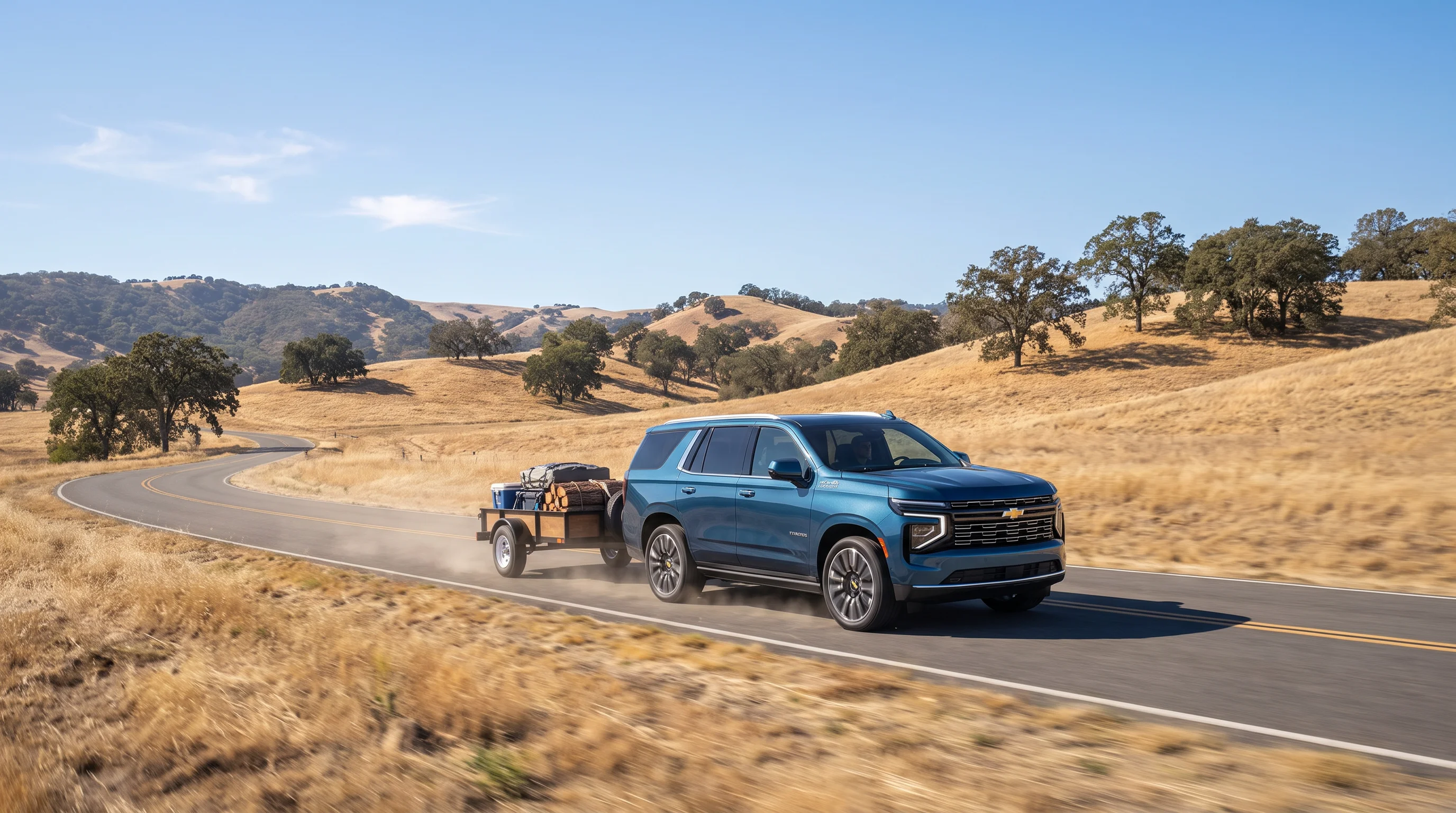
The 2026 Chevrolet Tahoe tows up to 8,400 pounds when properly equipped. That ceiling belongs to one build: rear-wheel drive, the standard 5.3L EcoTec3 V8, and the available Max Trailering Package. Chevrolet lists 8,400 lbs as the maximum available towing capacity for the 2026 Tahoe.
Getting to that number is about matching the powertrain to what you actually pull. The 5.3L EcoTec3 V8 produces 355 horsepower and 383 lb-ft of torque, and it holds the highest rating in the lineup. Two more engines are offered for 2026. The 6.2L EcoTec3 V8 is standard on High Country and available on RST, Z71 and Premier, delivering 420 horsepower and 460 lb-ft of torque. The 3.0L Duramax turbo-diesel inline-six generates 305 horsepower and 495 lb-ft of torque, and it is the choice for drivers who want steady pulling power over long distances.
Every engine pairs with a 10-speed automatic transmission built to hold the power band under load. Equipment matters as much as engine choice. Without the optional trailering hardware, a 5.3L Tahoe is rated at 7,900 pounds in rear-wheel drive and 7,700 pounds with four-wheel drive. Four-wheel-drive builds sit below their rear-drive counterparts across the lineup, because the added hardware raises vehicle weight and that weight comes out of the tow rating.
Maximum towing and payload capacity figures are based on properly equipped vehicles and vary by configuration. Do not exceed any weight rating. See your owner’s manual and the vehicle’s door-jamb label for specific capacities.
How the Max Trailering Package Changes Tahoe Capability
The Max Trailering Package is the option that unlocks the Tahoe’s highest tow rating. Without it, a 5.3L EcoTec3 V8 rear-wheel-drive Tahoe caps at 7,900 pounds. Adding the package raises capacity by 500 pounds to the peak rating of 8,400 pounds. It carries the RPO code NHT and is optional on every trim.
Maximum towing and payload capacity figures are based on properly equipped vehicles and vary by configuration. Do not exceed any weight rating. See your owner’s manual and the vehicle’s door-jamb label for specific capacities.
The package is more than a hitch. It bundles the cooling and control hardware that makes the higher rating possible, and on four-wheel-drive builds it adds off-road hardware as well.
Trailer Brake Controller
Integrated control of electric trailer brakes from the driver seat (RPO JL1).
Extra Capacity Cooling
Added cooling capacity to manage engine and transmission heat under load (RPO V03).
2-Speed Active Transfer Case
Included on four-wheel-drive models for low-range capability (RPO NQH).
Hill Descent Control
Included on four-wheel-drive models for controlled descents (RPO JHD).
Package contents are documented at the RPO level by Cars.com. Beyond the package itself, the Tahoe offers an available 17.7-inch diagonal center touchscreen and available Super Cruise hands-free driver assistance, which operates on compatible highways.
Driver-assistance and advanced safety systems are supplemental aids and are not substitutes for safe and attentive driving. Availability, operation, and effectiveness vary by trim and equipment and depend on factors including road, weather, traffic, and vehicle condition. Always keep your hands on the wheel and your eyes on the road. See your owner’s manual for system limitations and details.
Towing Capacity by Engine and Configuration
Tow ratings move with engine, drivetrain, and trailering equipment. Here is how the 2026 Tahoe’s configurations line up.
| Engine & Configuration | Horsepower | Torque | Max Towing |
|---|---|---|---|
| 5.3L EcoTec3 V8 — RWD with Max Trailering Package | 355 hp | 383 lb-ft | 8,400 lbs |
| 5.3L EcoTec3 V8 — RWD, standard trailering equipment | 355 hp | 383 lb-ft | 7,900 lbs |
| 5.3L EcoTec3 V8 — 4WD, standard trailering equipment | 355 hp | 383 lb-ft | 7,700 lbs |
| 6.2L EcoTec3 V8 — properly equipped | 420 hp | 460 lb-ft | 8,200 lbs |
| 3.0L Duramax Turbo-Diesel — properly equipped | 305 hp | 495 lb-ft | 8,200 lbs |
Maximum towing and payload capacity figures are based on properly equipped vehicles and vary by configuration. Do not exceed any weight rating. See your owner’s manual and the vehicle’s door-jamb label for specific capacities.
What You Can Safely Tow
An 8,400-pound maximum covers a wide range of recreational gear, livestock, and work equipment. Calculating total tow weight means adding your trailer, full fuel and water tanks, equipment, and cargo together. Then confirm that total sits under the rating for your specific build.
| Trailer Type | Typical Empty or Dry Weight | Within the Tahoe’s 8,400-lb Maximum |
|---|---|---|
| 24-foot travel trailer | About 4,400 lbs average; heavier floor plans reach roughly 6,500 lbs | Yes, with margin for fluids and gear |
| Two-horse bumper-pull trailer | About 2,400 lbs without a dressing room; about 3,200 lbs with one | Yes, with margin for horses and tack |
Maximum towing and payload capacity figures are based on properly equipped vehicles and vary by configuration. Do not exceed any weight rating. See your owner’s manual and the vehicle’s door-jamb label for specific capacities.
24-Foot Travel Trailers
A 24-foot travel trailer is one of the most common matches for a full-size SUV. The average 24-foot camper carries a dry weight near 4,400 pounds, according to Camper Report. Heavier floor plans reach roughly 6,500 pounds. Loaded with fresh water, LP tanks, and camping gear, most stay inside the Tahoe’s pulling limit.
Two-Horse Bumper-Pull Trailers
A two-horse bumper-pull trailer is another realistic load. Trailer builder Double D Trailers puts a standard two-horse bumper-pull at roughly 2,400 pounds empty without a dressing room, and about 3,200 pounds with one. Add two average 1,200-pound horses plus tack and hay, and the loaded package still sits well inside the Tahoe’s limits.
Before You Load
Navigating the suburban highway corridors around Far North Dallas rewards careful load balancing. Always verify the gross vehicle weight rating on your trailer’s VIN tag before loading. If you need more room than the Tahoe offers, our 2026 Suburban towing capacity breakdown covers the longer-wheelbase option.
How Towing Affects Fuel Economy and Payload
Fuel Economy Under Load
Towing increases aerodynamic drag and engine workload, and fuel economy drops accordingly with any engine. A rear-wheel-drive 2026 Chevrolet Tahoe with the 5.3L EcoTec3 V8 is rated at an EPA-estimated 15 mpg city, 20 mpg highway, and 17 mpg combined. Pulling a loaded trailer will cut those figures meaningfully. Actual results vary with trailer frontal area, terrain, and highway speed. Ratings for any specific configuration are published at fueleconomy.gov.
The 3.0L Duramax turbo-diesel is the efficiency choice in this lineup. In rear-wheel drive it carries an EPA-estimated 24 mpg combined rating. Under load, its 495 lb-ft of torque arrives low in the rev range, which keeps the engine working less hard than the gas V8s.
EPA-estimated fuel economy figures are for comparison purposes only. Your actual mileage will vary depending on driving conditions, how you drive and maintain your vehicle, battery age/condition, and other factors.
Payload and Tongue Weight
Payload deserves as much attention as towing, and it is where most shoppers get caught. The maximum payload rating for the 2026 Tahoe reaches 1,834 pounds. Payload covers everything the vehicle carries, including passengers, cabin cargo, and trailer tongue weight.
Tongue weight typically runs 10 to 15 percent of loaded trailer weight on a conventional bumper-pull trailer. On an 8,400-pound trailer, that is roughly 840 to 1,260 pounds landing on the hitch, and it comes straight out of payload. At the top of the tow rating, the trailer alone can consume close to half or more of what the Tahoe is rated to carry. That leaves less for people and gear than the headline number suggests. For the full picture on interior space, see our 2026 Tahoe cargo space and dimensions guide.
Maximum towing and payload capacity figures are based on properly equipped vehicles and vary by configuration. Do not exceed any weight rating. See your owner’s manual and the vehicle’s door-jamb label for specific capacities.
Built for the Long Haul
The Tahoe has repeatedly led J.D. Power dependability rankings among full-size SUVs, scoring 83 out of 100 for the 2014, 2020, and 2021 model years.
Structurally, the Tahoe is a body-on-frame SUV assembled at GM Arlington Assembly in Arlington, Texas. The frame absorbs the torsional stress that heavy tongue weights generate. Component choices like DURALIFE brake rotors, heavy-duty cooling circuits, and the 10-speed automatic transmission are engineered to resist heat buildup, which is a leading driver of transmission wear during heavy towing. Adhering to severe-duty service intervals for gear oil and fluid changes protects driveline parts across high mileage.
The information in this article is general guidance and does not constitute a specific diagnostic or repair recommendation for any individual vehicle. Repair and maintenance decisions should be made in consultation with a certified technician based on the specific condition of your vehicle.
Common Questions About 2026 Chevy Tahoe Towing
Which engine achieves the highest 8,400-pound towing capacity?
The standard 5.3L EcoTec3 V8 reaches the peak 8,400-pound rating when paired with rear-wheel drive and the Max Trailering Package. The larger 6.2L EcoTec3 V8 produces more horsepower and torque, but its higher curb weight brings its maximum rating to 8,200 pounds.
Can a Chevy Tahoe tow a 24-foot travel trailer safely?
Yes, a properly equipped 2026 Chevrolet Tahoe handles most 24-foot travel trailers. The average 24-foot camper has a dry weight near 4,400 pounds, leaving margin below the Tahoe’s 8,200 to 8,400-pound limits for fluids, passengers, and gear. A weight-distribution hitch is recommended for stable highway tracking.
What is the maximum payload rating for the 2026 Chevy Tahoe?
The maximum payload rating is 1,834 pounds. Payload varies with optional equipment, trim, and four-wheel-drive hardware, so always check the tire and loading information decal on the driver door jamb.
Can a Chevy Tahoe haul a two-horse trailer?
Yes. A standard two-horse bumper-pull trailer weighs roughly 2,400 to 3,200 pounds empty depending on whether it has a dressing room. Adding two 1,200-pound horses plus equipment keeps the loaded weight well inside Tahoe tow limits.
Find Your Tow-Ready 2026 Chevy Tahoe
Choosing the right 2026 Chevrolet Tahoe comes down to matching your trailering requirements to the right engine, drivetrain, and equipment package. The lineup runs through six trims: LS, LT, RST, Z71, Premier, and High Country. If towing is a priority, the Max Trailering Package is the single box that matters most. Full 2026 Tahoe trims and pricing are broken down separately, and our 2026 Tahoe overview covers the model end to end.
Our team can walk you through specs, explain hitch setup, or demonstrate the trailering camera views in person. Families driving from University Park, Farmers Branch, Addison, and Richardson can reach us quickly for a test drive under real road conditions. When you are ready, take the short drive to our dealership on Lyndon B Johnson Freeway and test drive a tow-ready Chevy Tahoe today.
Disclaimers
Maximum towing and payload capacity figures are based on properly equipped vehicles and vary by configuration. Do not exceed any weight rating. See your owner’s manual and the vehicle’s door-jamb label for specific capacities.
EPA-estimated fuel economy figures are for comparison purposes only. Your actual mileage will vary depending on driving conditions, how you drive and maintain your vehicle, battery age/condition, and other factors.
Driver-assistance and advanced safety systems are supplemental aids and are not substitutes for safe and attentive driving. Availability, operation, and effectiveness vary by trim and equipment and depend on factors including road, weather, traffic, and vehicle condition. Always keep your hands on the wheel and your eyes on the road. See your owner’s manual for system limitations and details.
The information in this article is general guidance and does not constitute a specific diagnostic or repair recommendation for any individual vehicle. Repair and maintenance decisions should be made in consultation with a certified technician based on the specific condition of your vehicle.
