Open Today Sales: 9 AM-7 PM
Your tires are the only part of your Chevrolet that actually touches the road, which makes tire rotation and wheel balancing two of the most cost-effective services you can schedule. Done on time, they promote even tread wear, smooth out your ride, and protect your suspension and drivetrain. This guide walks through how rotation and balancing work, the correct patterns for different drivetrains, how to tell when something’s wrong, and the factory maintenance benefits that come with your Chevrolet.
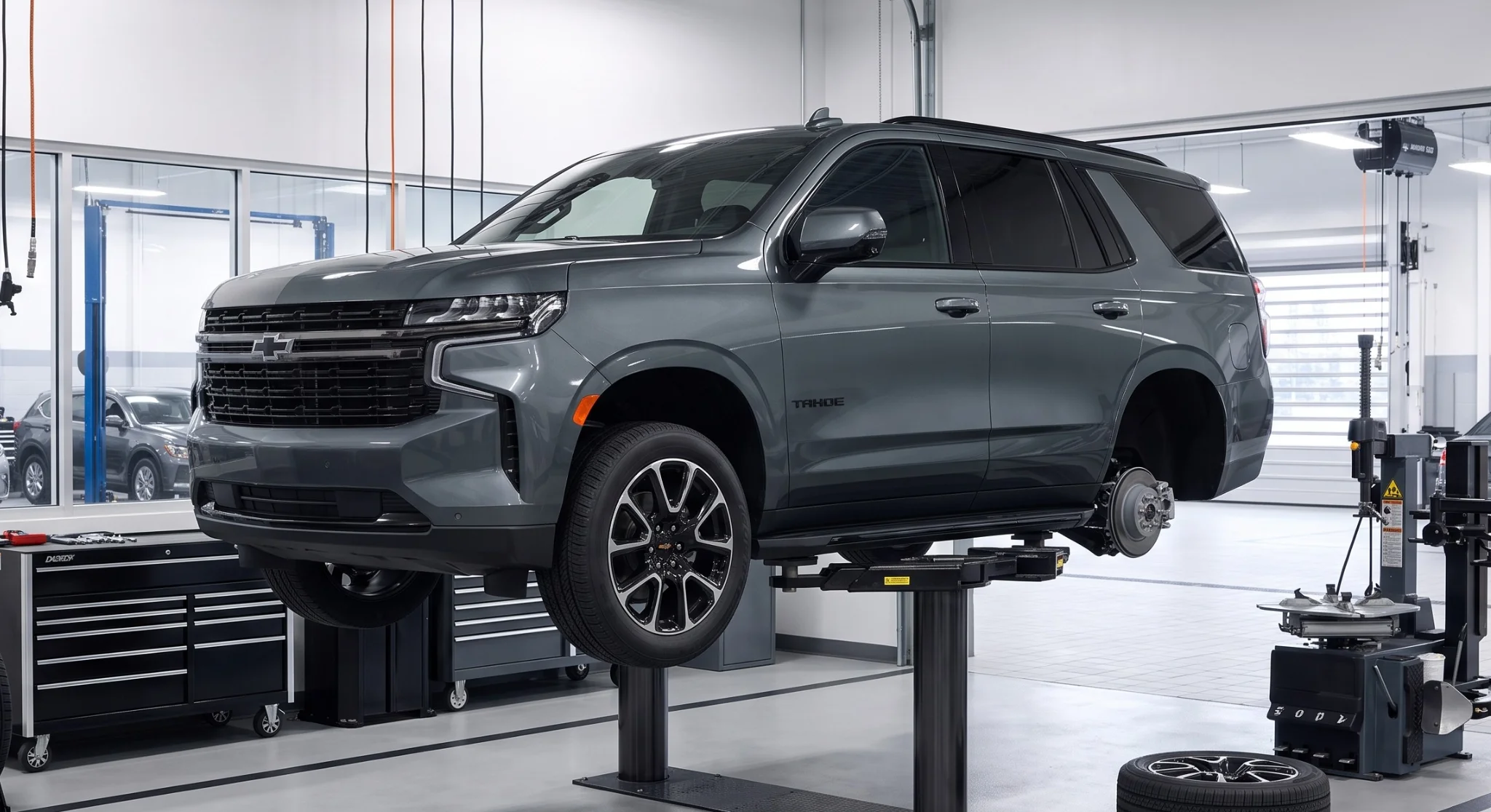
These two services are often confused, but they solve different problems and are frequently done together. A rotation relocates your wheels to even out tread wear; a balance corrects weight distribution so the ride stays smooth. Here’s how they compare:
| Tire Rotation | Wheel Balancing | |
|---|---|---|
| What it does | Relocates wheels to different positions on the vehicle | Corrects uneven weight distribution in the wheel assembly |
| Solves | Uneven tread wear | Vibration and premature cupping |
| Equipment | Jack and torque wrench | Computerized balancing machine |
| Typical interval | About every 7,500 miles | As needed, or when vibration appears |
Tire balancing equalizes the weight of the tire-and-wheel assembly. Even high-quality tires have minor manufacturing imperfections that make one section slightly heavier than another, and at highway speed those small discrepancies generate significant centrifugal force. During a balancing service, technicians spin the assembly on a balancing machine to locate heavy spots, then attach small calibrated weights to the rim to counteract them.
Most passenger vehicles use non-directional tires, which allow more versatile rotation patterns. The right pattern depends on how your vehicle drives its wheels and how weight is distributed across the axles.
| Drivetrain / Tire Type | Pattern | How It Works |
|---|---|---|
| Front-wheel drive (non-directional) | Forward cross | Fronts move straight back to the same side; rears cross to the opposite front positions |
| Directional tires (any drivetrain) | Same-side front-to-rear | Each tire stays on its side, moving straight front to rear — never crossed |
| All-wheel drive | Cross rotation, more frequent | Rotated more often than the standard interval to keep tread depths even across all four |
| Dual-rear-wheel (dually) truck | Six-tire circular | Fronts to inner rear, inner rear to outer rear, outer rear to front — same side, no crossing |
On a front-wheel-drive vehicle, the front tires handle steering, braking, and acceleration, so they carry the heaviest workload. The forward cross pattern moves the front tires straight back to the rear on the same side, while the rear tires cross over to the opposite front positions. This helps equalize the load on the drive wheels.
Dual-rear-wheel trucks carry six tires, and the inner and outer rear tires wear differently than the front steering tires because they handle different loads. The standard six-tire circular pattern keeps each tire on its own side of the truck: the fronts move to the inner rear, the inner rear tires move to the outer rear, and the outer rear tires move up to the front. This is best completed at your regular service interval — roughly every 7,500 miles, and more often if the truck is used for heavy hauling.
Whether you drive a front-wheel-drive crossover or a heavy-duty dually, staying on the factory-recommended rotation schedule is the best way to protect your tire investment.
Out-of-balance wheels produce distinct symptoms that are easy to recognize once you know what to feel for:
A note on staggered setups: some performance models run wider tires on the rear axle than the front. If those staggered tires are non-directional, they can only be rotated side-to-side on the same axle. If they are both directional and staggered, they generally can’t be rotated at all without dismounting the tires from the wheels.
Directional tires use a specialized tread pattern designed to roll in only one direction. The tread blocks are molded in a V-shaped pattern that channels water away from the contact patch to reduce hydroplaning and improve wet-weather grip. You can identify them by the arrow on the sidewall indicating the required direction of rotation.
Because of that design, directional tires follow a different rule than standard tires:
If your vehicle has directional tires or you’ve noticed unusual tread wear, our factory-trained technicians will inspect your tread depth, verify your tire type, and execute the correct pattern. To speak with a service advisor about your vehicle’s maintenance needs, call our service team at 361-272-3064 or schedule a service appointment online.
Every new Chevrolet includes owner benefits that make staying on top of tire maintenance easier — and keeping good service records helps protect your coverage.
| Benefit | Coverage | What It Includes |
|---|---|---|
| First scheduled maintenance visit | First 12 months of ownership | Oil and filter change, Multi-Point Inspection, and a four-tire rotation |
| Bumper-to-Bumper Limited Warranty | 3 years / 36,000 miles | Vehicle defect repairs; original tires covered on a prorated basis after 12,000 miles |
| Powertrain Limited Warranty | 5 years / 60,000 miles | Major engine and drive-system components |
| Roadside Assistance | 5 years / 60,000 miles | Separate coverage — towing, flat-tire changes, jump-starts, lockout service |
Your first scheduled maintenance visit is covered at a participating Chevrolet dealership within the first 12 months and includes a professional oil and filter change, a Multi-Point Vehicle Inspection, and a complete four-tire rotation. Using this benefit gets your tires rotated at the important early-mileage mark and establishes a healthy wear pattern from the start.
Keeping detailed records of regular rotations and alignments at an authorized dealership documents that your vehicle has been cared for to factory standards — which is valuable if you ever need to make a warranty claim.
This information is provided for general educational purposes only and does not constitute legal advice. Warranty coverage depends on the specific terms of your vehicle’s warranty agreement. Consult your owner’s manual or a qualified legal professional for guidance on your individual situation.
Dealership service specials help keep your maintenance costs manageable without sacrificing quality. We regularly offer coupons on essential tire services, including:
Bundling a rotation and balance together keeps your tires wearing evenly and spinning smoothly while keeping your maintenance budget on track.
When it’s time to replace worn tires, original-equipment parts help preserve your vehicle’s factory ride quality and safety systems. Our parts department stocks GM Genuine Parts and ACDelco tires matched to your model’s suspension tuning and weight distribution. You can review current offers on our Service & Parts Specials page before your next visit.
Yes — always clarify this with your service advisor. A standard rotation simply relocates the wheels to different positions to promote even tread wear. Balancing is a separate, more technical service that mounts the wheel on a specialized machine to detect and correct weight imbalances. If you’re experiencing highway-speed vibration, specifically request a balance in addition to your rotation.
For a flat, breakdown, or other road emergency, contact Chevrolet Roadside Assistance at 1-800-243-8872. This manufacturer-backed program is available 24 hours a day, 365 days a year, and is included for 5 years or 60,000 miles. Benefits include emergency towing to the nearest Chevrolet dealer, flat-tire changes using your spare, battery jump-starts, vehicle unlock service, and emergency fuel delivery.
Your tires have built-in Tread Wear Indicators — narrow bars of smooth rubber molded into the tread grooves. According to the National Highway Traffic Safety Administration (NHTSA), tires are not safe and should be replaced when the tread is worn down to 2/32 of an inch — the point at which these bars become level, or flush, with the surrounding tread. Chevrolet’s own tire-maintenance guidance goes a step further, advising owners to replace tires before the tread wears all the way down to the indicator bars rather than waiting for them to become flush. Watch for these replacement signals:
If you notice any of these, the tire is no longer safe and should be replaced right away. For more on tire safety, see the NHTSA tire information page at nhtsa.gov/vehicle-safety/tires.
All-wheel-drive systems send power to all four wheels, so every tire is under continuous driving force. Because the front tires also handle steering and most of the braking, they tend to wear at a different rate than the rears. Rotating more frequently than the standard 7,500-mile interval keeps tread depths even, which protects the transfer case and center differential from strain caused by mismatched tire diameters.
No — the number on the sidewall is the maximum pressure the tire can hold under maximum load, not the recommended pressure for your vehicle. Always use the Tire and Loading Information placard on the driver-side door jamb, which lists the correct cold inflation pressure engineered for your vehicle’s ride quality, handling, and fuel economy.
Maintaining your tires is one of the simplest, most effective ways to keep your Chevrolet driving safely and smoothly. From precise rotations for directional tread patterns to computerized wheel balancing, our certified technicians have the training, equipment, and genuine parts to keep your vehicle performing at its best. Don’t wait for a minor vibration or uneven wear pattern to turn into an expensive repair.
Our service center is located on the LBJ Freeway in Dallas, easy to reach from Farmers Branch, Addison, University Park, and across the metroplex. When you’re ready to book, schedule a service appointment online or call our service team at 361-272-3064.
The information on this page is provided for general informational purposes only and reflects manufacturer specifications believed accurate at the time of publication. Specifications, capacities, service intervals, rotation patterns, and maintenance recommendations are subject to change and may vary by model year, trim, and configuration. Always confirm the correct tire type, rotation pattern, and inflation pressure against your vehicle’s owner’s manual and the driver-side door-jamb label before servicing. Consult a certified technician for service specific to your vehicle.
Content provided for general informational and educational purposes. Vehicle maintenance intervals, coverage terms, and specifications vary by model, model year, and configuration. Consult your owner’s manual or contact Galleria Chevrolet’s service department for details specific to your vehicle.