Open Today Sales: 9 AM-7 PM

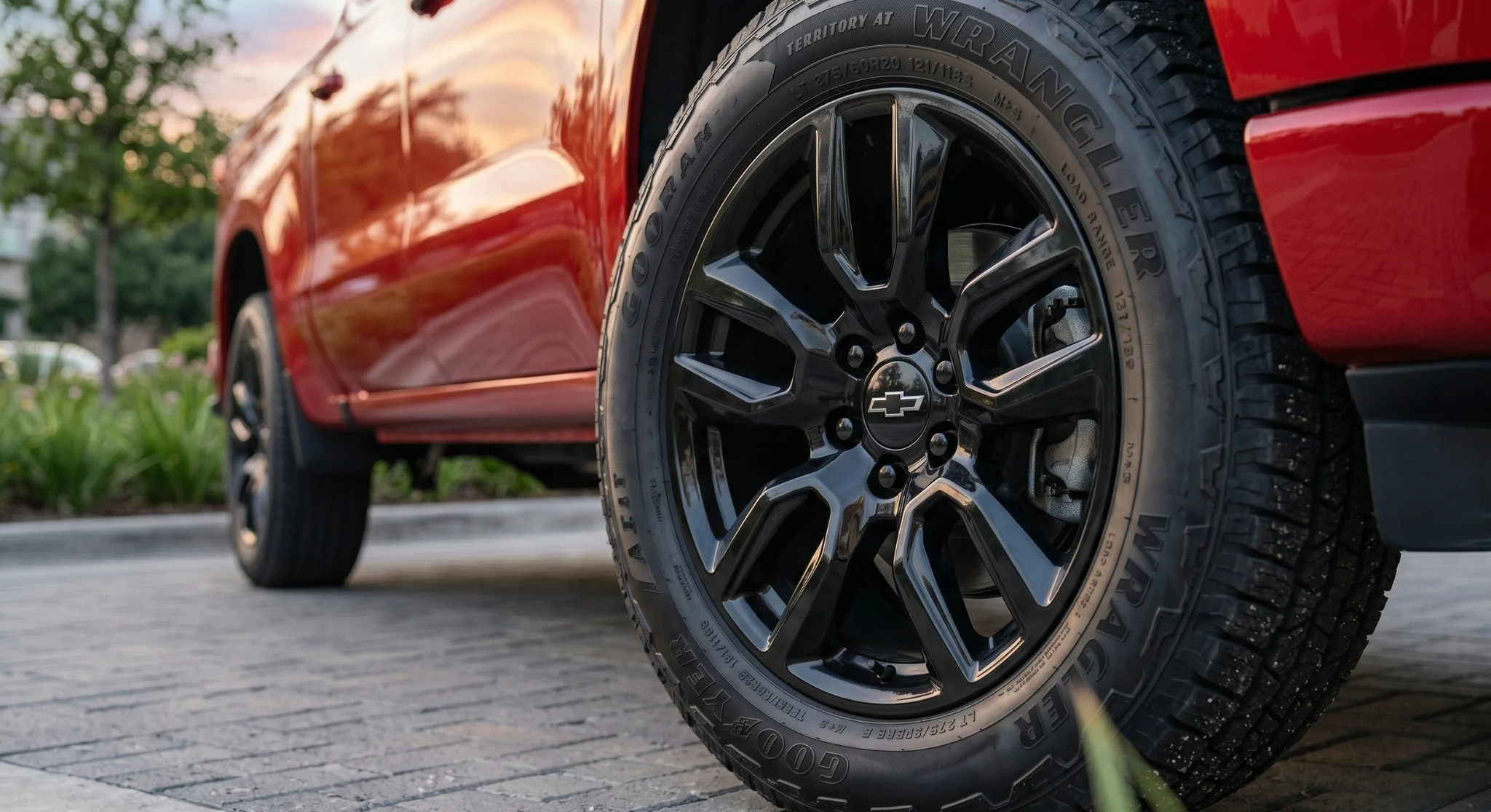
Maintaining the correct tire pressure is one of the most impactful — and most overlooked — pieces of routine maintenance. The right PSI affects handling, braking distance, fuel economy, tread wear, and how your Chevy holds up over 50,000+ miles of Dallas driving. This guide covers the recommended cold tire pressure for every current Chevrolet model, plus values for several recently discontinued models still on the road. Whether you drive a Trax around Farmers Branch, a Silverado 1500 between Carrollton and Richardson, or a brand-new Equinox EV through Irving — this is your reference.
Every Chevrolet has a Tire and Loading Information label on the driver’s-side door jamb. That sticker — set by GM specifically for your vehicle’s exact weight, wheel size, and tire spec — is the authoritative source. The chart below is a useful reference, but if your door jamb shows a different value, follow the door jamb. Trim level, wheel size, and original tire spec all affect the recommended PSI.
The values below are typical recommended cold tire pressures for current-production Chevy models in standard configurations.
| Model | Recommended Cold PSI |
|---|---|
| Chevy Trax | 35 front / 32 rear |
| Chevy Trailblazer | 35 psi |
| Chevy Equinox | 35 psi |
| Chevy Blazer | 35 psi |
| Chevy Traverse | 35 psi |
| Chevy Tahoe | 35 psi (some 20″ wheel trims: 32–33 psi) |
| Chevy Suburban | 35 psi |
| Model | Recommended Cold PSI |
|---|---|
| Chevy Colorado | 35 psi |
| Chevy Silverado 1500 | 35 psi |
Heavy-duty trucks operate at substantially higher pressures than light-duty pickups, and values vary meaningfully by configuration — gas vs. diesel, single rear wheel (SRW) vs. dual rear wheel (DRW), and payload package all matter. The placard on your specific truck is essential here.
| Model | Typical Recommended Cold PSI |
|---|---|
| Chevy Silverado 2500HD | ~60 front / ~65–70 rear |
| Chevy Silverado 3500HD (SRW) | ~60 front / ~65–70 rear |
| Chevy Silverado 3500HD (DRW) | ~60 front / up to 80 rear |
If you’re towing near max capacity or running with a loaded payload, the door jamb may direct you to run the rear tires at the maximum sidewall pressure. Confirm against your placard before each heavy tow.
EVs run higher pressures than their gas counterparts because of added battery weight and efficiency-tuned suspension calibration. If you’re cross-referencing the value with the gas Equinox above, do not use 35 psi on an Equinox EV — you’d be 7 psi under spec.
| Model | Recommended Cold PSI |
|---|---|
| Chevy Equinox EV | 42 psi |
| Chevy Blazer EV | 38–42 psi (varies by trim and wheel package) |
The 2025 Blazer EV SS uses staggered pressures — 38 psi front and 42 psi rear. The Blazer EV 2LT with higher-profile tires reads 42 psi. RS AWD trims show 38 psi. The door jamb is the only way to know which spec applies to your exact configuration.
A current Equinox EV weighs roughly 5,300–5,800 pounds — about a thousand pounds heavier than the gas Equinox. Higher cold tire pressure supports that extra mass without sidewall flex, reduces rolling resistance (range matters more on an EV), and helps the tires maintain their designed contact patch under hard regenerative braking. The same principle is even more pronounced on Blazer EV and on Silverado EV.
If you’ve recently switched from a gas Chevy to a Chevy EV, do not assume your prior PSI habits carry over. Check the new door jamb on day one.
The Tire Pressure Monitoring System (TPMS) handles two scenarios differently, and modern Chevys do not have the old “TPMS button under the steering wheel” — that hardware reset disappeared more than a decade ago.
Once you bring all four tires (and the spare, if equipped) up to the recommended cold pressure, drive the vehicle for about 10 to 20 minutes at speeds above 20 mph. The system will normally clear the warning on its own once each sensor reports an in-range value.
This requires a manual position relearn, since each sensor needs to be matched to its new wheel position. On most current Silverado, Tahoe, Suburban, Equinox, Traverse, and Trax models:
If your dash uses a newer interface, the relearn can also be triggered through the Driver Information Center menu: Vehicle → Tire Pressure → Sensor Matching. If the warning light stays on after either procedure, the system may have a faulty sensor or a slow leak that needs eyes on it from our service team.
Air expands as it heats. Industry-standard guidance — used by NHTSA, tire manufacturers, and OEMs — is that tire pressure rises or falls roughly 1 PSI for every 10°F change in ambient temperature. In Dallas, where summer afternoons routinely climb 35–40 degrees above cool morning temperatures, that means a tire set to 35 psi at 7 a.m. can easily read 39–40 psi by 3 p.m. in direct sun.
A few practical takeaways for Texas summer driving:
These models are no longer in production but remain common on Dallas-area roads. Recommended cold tire pressures for owners of these vehicles:
| Model | Final Model Year | Recommended Cold PSI |
|---|---|---|
| Chevy Camaro (6th-gen) | 2024 | 32 psi |
| Chevy Malibu (9th-gen) | 2025 | 32–35 psi |
| Chevy Cruze | 2019 (US) | 32–35 psi |
| Chevy Bolt EV (1st-gen) | 2023 | 36 psi |
| Chevy Bolt EUV | 2023 | 38 psi |
Confirm against your specific door jamb sticker, especially on older vehicles where the original tires may have been replaced with different sizes.
If you’re not sure what PSI applies to your specific Chevy, or if your TPMS light stays on after you’ve adjusted pressures, our service team can check, adjust, and verify your tire pressure in minutes — and inspect for slow leaks, valve stem issues, or sensor faults while you’re here. We serve drivers across Dallas, Farmers Branch, Carrollton, Richardson, Irving, and Grapevine.
Call our service team at (361) 272-3064 or visit us at 4747 LBJ Fwy, Dallas, TX 75244.
Disclaimer: The tire pressure values in this guide are typical recommendations for standard configurations and are intended as a general reference only. Your specific vehicle’s recommended PSI may differ based on trim level, wheel package, original tire equipment, or model year revisions. Always defer to the Tire and Loading Information label on your driver’s-side door jamb and your owner’s manual as the authoritative sources. TPMS reset procedures may vary by model and may require dealer assistance in some cases. If you have questions about your specific vehicle, contact the Galleria Chevrolet service team.
Browse Silverado 1500 Inventory Contact Our Truck Specialists What is new on the 2027 Chevrolet Silverado 1500? The 2027 Chevrolet Silverado 1500 is a full redesign, not a refresh. Chevrolet revealed the truck on June 16, 2026. It brings two new small-block V8 engines, an all-new exterior, and a fully digital cockpit. The cockpit is…
Contact Our Truck Team Browse New Silverado 2500HD Inventory The 2026 Chevrolet Silverado 2500HD Work Truck is built for commercial contracting. It pairs a standard 401-horsepower 6.6L V8 gas engine with an Allison 10-speed automatic transmission. Conventional towing reaches up to 16,000 pounds on gas models and up to 20,000 pounds with the available Duramax…
Football season means loading up and heading out early. You need cargo space, reliable power, and confidence in a packed parking lot. This guide walks through how to set up a Chevrolet Silverado or a Chevrolet Traverse for game day. Galleria Chevrolet serves tailgaters across Far North Dallas, Addison, Farmers Branch, Carrollton, Richardson, Plano, Highland…